Kinsale Community School’s Jean Monnet Learning EU Initiative
Kinsale Community School is proud to launch FÉILTE: Fostering European Identity through Learning and Teaching about Europe, an ambitious new initiative supported through the Jean Monnet Learning EU programme. The initiative was officially launched on Friday 14th of November by the European Commissioner Micheal Mc Grath.
FÉILTE expands our strong tradition of innovative teaching, global citizenship, and Erasmus engagement by helping students explore what it means to be European today. Through a structured Transition Year programme, cross-curricular learning, and student-led events, the initiative deepens students’ understanding of EU values, history, institutions, and citizenship.
FÉILTE aims to build a stronger sense of European identity within our school community and to empower students to become informed, engaged, and active European citizens. The project includes workshops, cultural events, EU study visits, and meaningful opportunities for young people to participate in democratic decision-making. The FÉILTE initiative is funded by the European Union and will be implemented over 36 months.
This initiative reflects our school ethos, “All Together in Learning,” and strengthens our commitment to inclusion, diversity, and global awareness.
Further information about EU Learning initiatives can be found here: Learning EU initiatives in other fields of education and training - Erasmus+
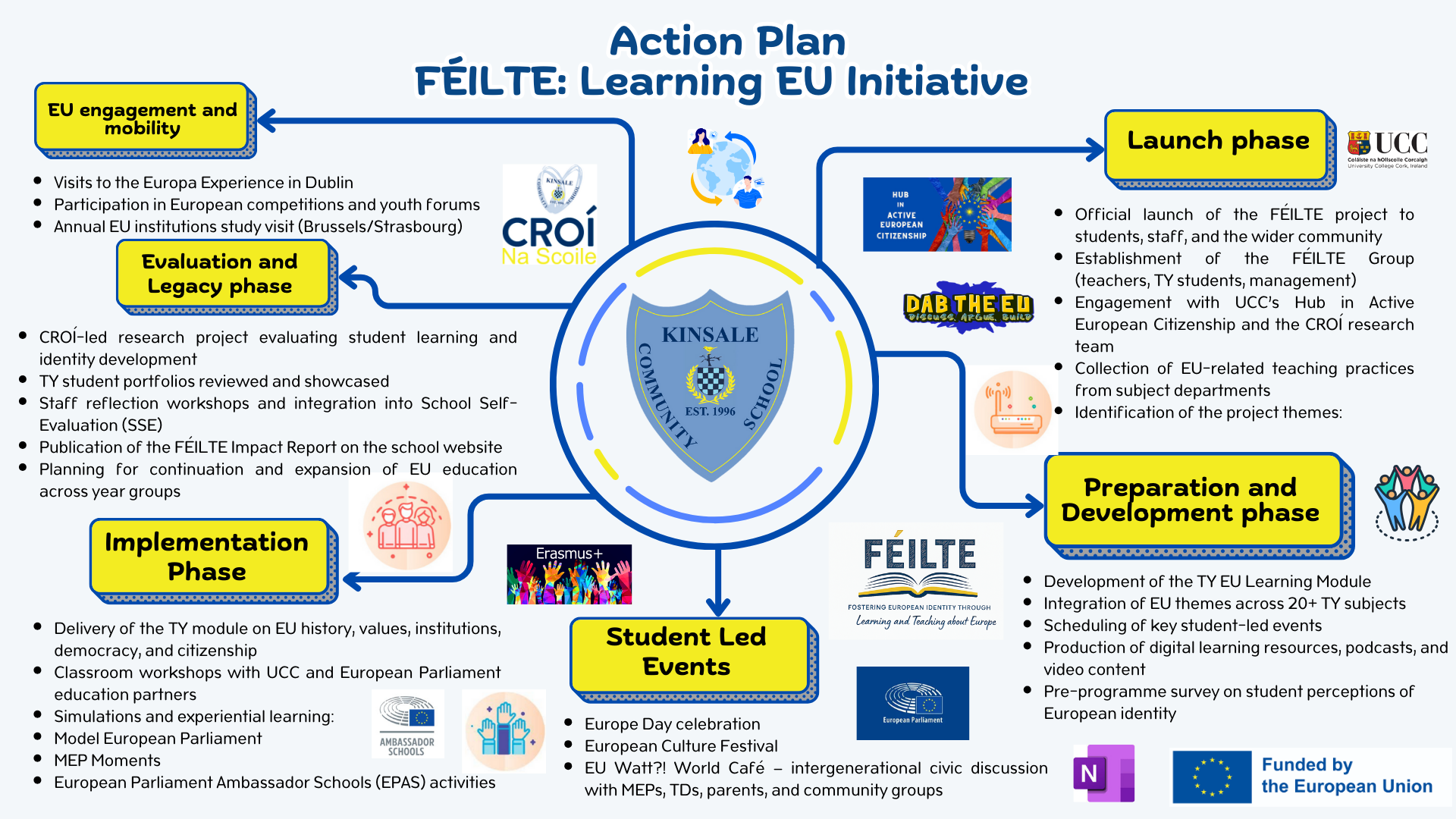
Action plan:
Key Stages of the FÉILTE Initiative
1. Launch Phase
Official launch of the FÉILTE project to students, staff, and the wider community
Establishment of the FÉILTE Group (teachers, TY students, management)
Engagement with UCC’s Hub in Active European Citizenship and the CROÍ research team
Collection of EU-related teaching practices from subject departments
Identification of the project themes:
European Identity
Inclusion
Sustainability & Active Citizenship
Culture & Community
2. Preparation and Development Phase
Development of the TY EU Learning Module
Integration of EU themes across 20+ TY subjects (e.g., English, Business, Art, Science, MFL, Maths)
Scheduling of key student-led events (Europe Day, Culture Festival, World Café)
Production of digital learning resources, podcasts, and video content
Pre-programme survey on student perceptions of European identity
3. Implementation Phase
Teaching & Learning
Delivery of the TY module on EU history, values, institutions, democracy, and citizenship
Classroom workshops with UCC and European Parliament education partners
Simulations and experiential learning:
Model European Parliament
MEP Moments
European Parliament Ambassador Schools (EPAS) activities
EYP involvement
Student-Led Events
Europe Day @ KCS – exhibitions, performances, debates, and cultural showcases
European Culture Festival – celebrating diversity within the school
EU Watt?! World Café – intergenerational civic discussion with MEPs, TDs, parents, and community groups
EU Engagement & Mobility
Visits to the Europa Experience in Dublin
Participation in European competitions and youth forums
Annual EU institutions study visit (Brussels/Strasbourg)
4. Evaluation & Legacy Phase
CROÍ-led research project evaluating student learning and identity development
TY student portfolios reviewed and showcased
Staff reflection workshops and integration into School Self-Evaluation (SSE)
Publication of the FÉILTE Impact Report on the school website
Planning for continuation and expansion of EU education across year groups